Occupancy volumes
A shape is represented as an occupancy INR \([-1, 1]^3 \to \{-1, 1\}\), fitted to a voxelized mesh and scored by intersection over union. This follows configs/occupancy.yaml and scripts/train_occupancy.py.
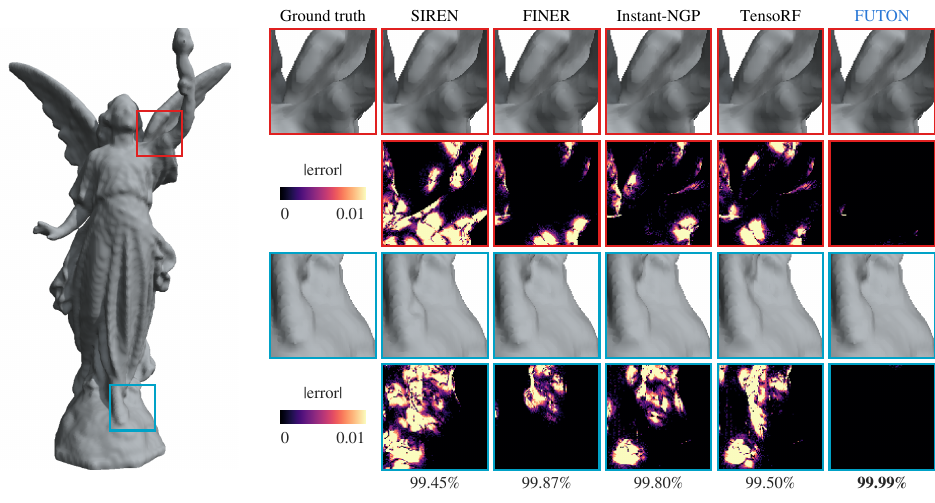
Data
OccupancyCoordinateDataset loads a mesh (any format trimesh reads, with the 3d extra) or an .xyz point cloud with normals, and then:
- Normalizesinto [−0.45, 0.45]³, as FINER and BACON do
- Voxelizesat
resolutionsamples per unit length - Cropsto the occupied bounds
- Cachesbeside the source, as
.cache/<name>_<resolution>.pt
import torch
import inro

path = "data/occupancy/lucy.ply"
train_set = inro.OccupancyCoordinateDataset(path, resolution=256, max_samples=2**18)
eval_set = inro.OccupancyCoordinateDataset(path, resolution=256)

eval_set.input.shape, eval_set.target.shape  # (depth, H, W, 3) coordinates, (depth, H, W, 1) targets in {-1, 1}
eval_set.original.shape                      # (1, depth, H, W) float occupancy in {0, 1}
At 256 samples per unit length a cropped volume holds 2 to 8 million voxels; max_samples=2**18 trains on 262,144 of them at random per step, as many for every shape. The five meshes of the benchmark are the Stanford armadillo, dragon, happy buddha, lucy and thai statue, fetched by scripts/download_meshes.py.
Model
The benchmark FUTON uses half the voxels along each axis of the cropped grid, a linear head, and the largest CP rank, a multiple of 5, that keeps it smaller than every baseline, the smallest of which has 131,457 parameters. Rank \(R\) costs \(R\) times the components plus one, and the head's bias adds 1, so Lucy's \(135 \times 78 \times 231\) grid gets 590, for 130,981 parameters:
components = [size // 2 for size in eval_set.grid_size]
rank = (131_456 - 1) // (sum(components) + 1) // 5 * 5
model = inro.FUTON(
    3, 1,
    basis=("cosine", {"num_components": components, "grid_size": eval_set.grid_size}),
    combiner=("cp", {"rank": rank}),
    head="linear",
    output_activation=torch.tanh,
)
On the voxel grid, which grid_size declares and which the crop sizes differently for every shape, the basis is evaluated once, when it is built, and each point reads its rows. The linear head reads a batch of \(2^{18}\) voxels off the whole grid in one contraction.
Training and evaluation
result = inro.train(
    model,
    train_set,
    eval_set,
    num_steps=1000,
    lr=1e-2,
    metrics={"iou": inro.iou},
    chunk_size=262144,  # (1)!
    log_interval=50,
    eval_interval=50,
    save_reconstruction=False,
    log_dir="logs/tutorial/lucy/FUTON",
)
print(result["history"][-1]["eval"]["iou"])  # (2)!
- Bounds the memory of evaluating the whole volume.
inro.iouthresholds the model's output at zero and compares it with the{0, 1}original.
Every model's IoU after the 1000 steps, and FUTON's convergence, are on the benchmarks page.
Exporting a mesh
With the 3d extra, eval_set.save(volume, path) smooths the occupancy, runs marching cubes, writes a .dae mesh and renders it offscreen to a .png with Open3D, drawing the grid's axis up upwards: Lucy stands along the last, the other four shapes along the second, the default.
volume = inro.chunked_inference(model, eval_set.input, chunk_size=262144)
occupancy = eval_set.postprocess(volume.cpu())  # (1, depth, H, W) in {0, 1}
eval_set.save(occupancy, "lucy_futon", up=2)    # lucy_futon.dae and .png
Rendering needs EGL and a GPU driver
Not every machine has them, which is why the call above and the benchmark script pass save_reconstruction=False and rebuild meshes from checkpoint.pt afterwards, with inro.evaluate(model, eval_set, ckpt_path=..., log_dir=...) on a workstation.
The benchmark script
python scripts/train_occupancy.py                                       # all shapes, all models
python scripts/train_occupancy.py --data data/occupancy/lucy.ply --models FUTON
FUTON's ablations run on images; the ablations page reports them.