
Inro is a PyTorch package for implicit neural representations (INRs): a unified framework for implementing, training and evaluating them. It features the official implementation of FUTON, introduced in our paper, and major INR architectures such as SIREN, FINER, RFF, Instant-NGP and TensoRF behind one interface. Reusable components and pipelines cover image and volume representation and novel view synthesis.
FUTON against the strongest baseline
Every model of a task has the same parameter budget, and times are median training times per signal on an A100, from the same runs as the scores. FUTON makes the best trade-off of speed and reconstruction quality on every task.
Images, Kodak
+0.90 dB
37.63 dB against MFN's 36.72, in 4.1 s against 57.3 s.
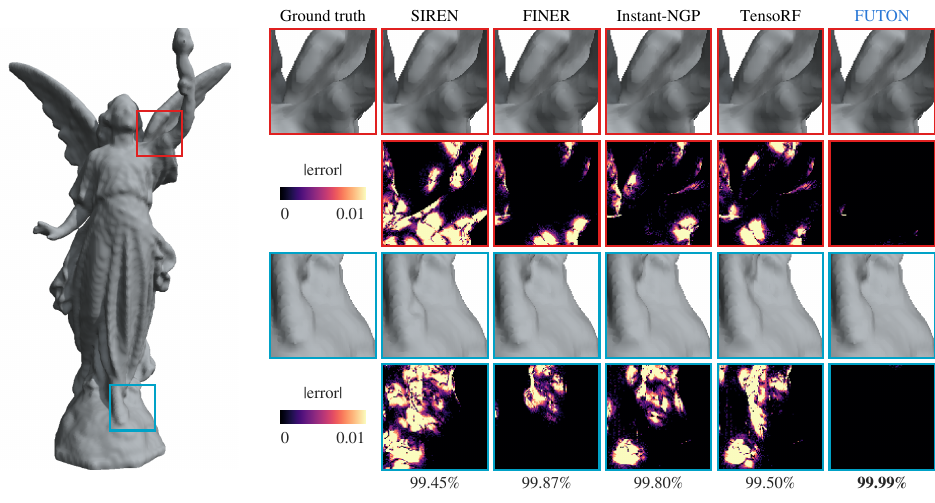
Occupancy, Stanford
+0.06 %
99.97 % IoU against RFF's 99.91 %, in 1.7 s against 11.7 s.
Radiance fields, Blender
+0.60 dB
29.22 dB against FINER's 28.62, in 152 s against 219 s.
How FUTON works
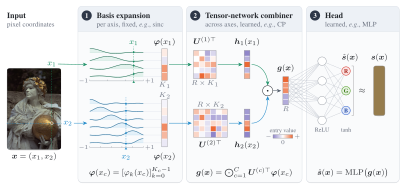
Most INRs hide their prior in the nonlinearity: sines, Gabor wavelets, Gaussians, or a hash-grid lookup in front of a ReLU network. FUTON puts the prior in the parameterization: the signal is expanded in a fixed basis along each coordinate axis, and the coefficient tensor of that expansion is stored in low-rank form.
-
Fast
A point costs \(O(CKR)\) for \(C\) axes, \(K\) basis functions per axis and rank \(R\). On a grid, each axis is evaluated once per distinct coordinate and shared by every point on it.
-
Accurate at equal size
At matched parameter counts FUTON leads every baseline on the average of Kodak images, Stanford occupancy volumes and Blender radiance fields.
-
Transparent
With a linear head FUTON is a rank-\(R\) CP model of the signal in the chosen basis, so bandwidth (\(K\)) and capacity (\(R\)) are explicit knobs, with a computable error bound.
See the difference
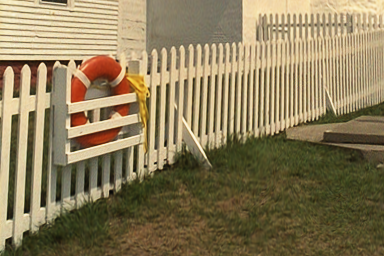
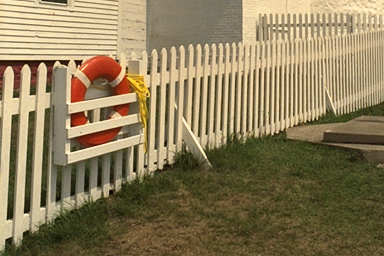
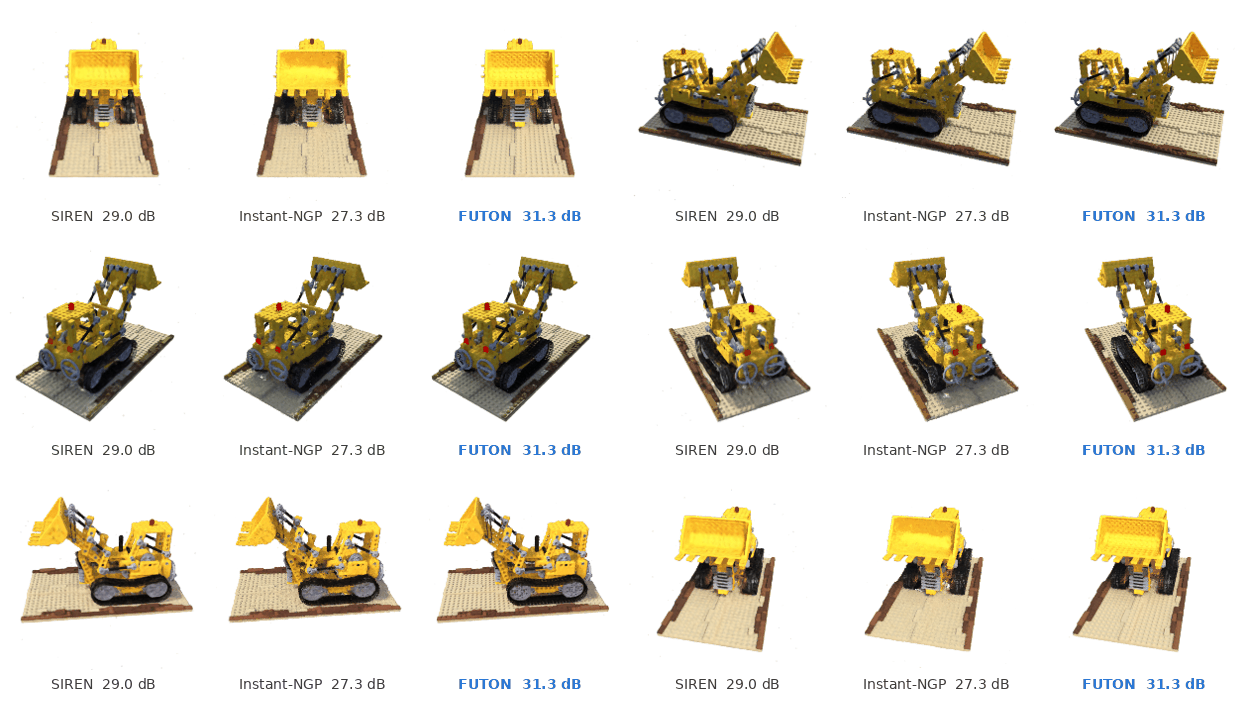
Results
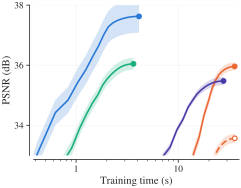
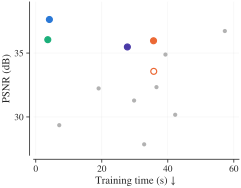
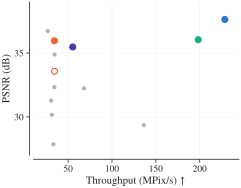
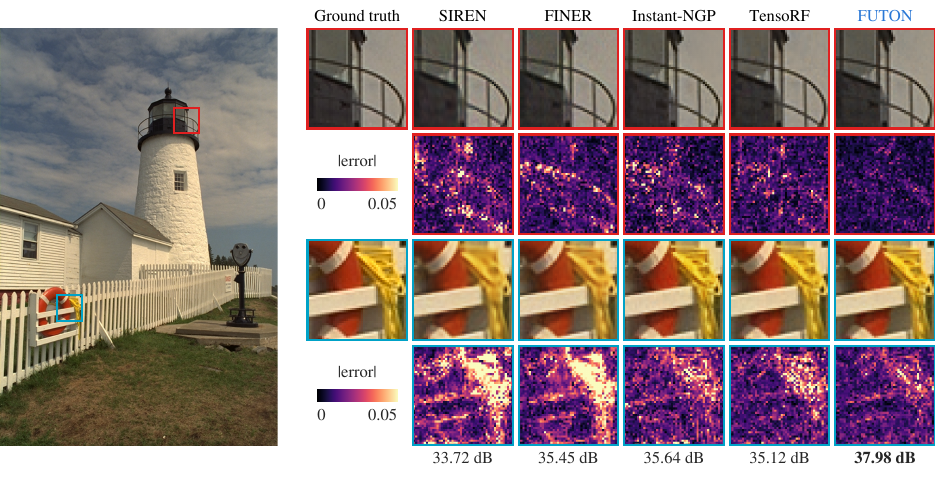
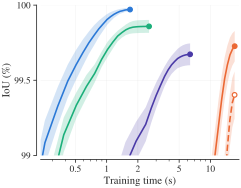
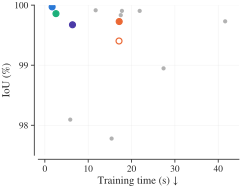
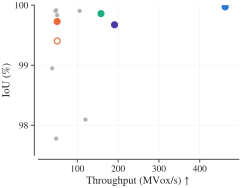
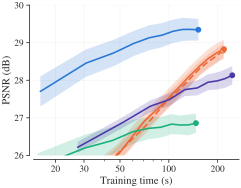
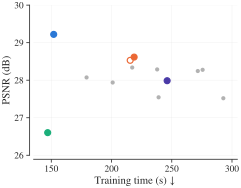
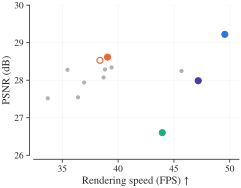
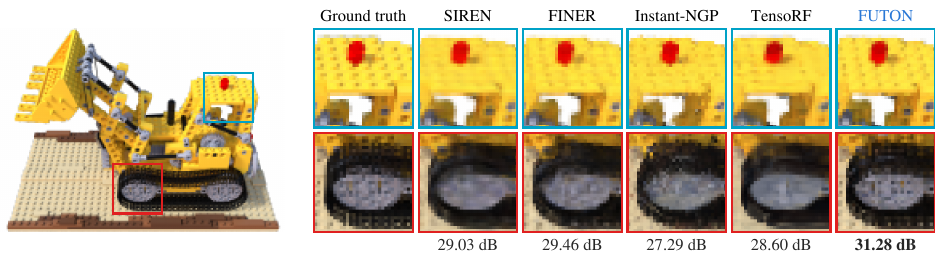
Quality against training time for FUTON and the strongest model of each family, with bands of one standard error; every model's final quality against its training time; and against its inference speed. The benchmarks page has every model, metric and error bar.
One interface
Every model maps coordinates in \([-1, 1]\) to values, so one training call fits them all.
import torch
import inro

dataset = inro.ImageCoordinateDataset("data/Kodak/kodim19.png")  # (1)!
H, W, _ = dataset.target.shape

model = inro.FUTON(  # (2)!
    in_features=2,
    out_features=3,
    basis=("cosine", {"num_components": [H // 2, W // 2]}),
    combiner=("cp", {"rank": 280}),
    head=("mlp", {"hidden_layers": 1, "hidden_features": 64}),  # (3)!
    output_activation=torch.tanh,
)

result = inro.train(model, dataset, dataset, num_steps=1000, lr=1e-1, metrics={"psnr": inro.psnr})
print(result["history"][-1]["eval"])  # {"psnr": 37.8}
- Any RGB image: a path, a tensor or a PIL image. Each access returns every pixel's coordinates and color.
- Swap in any other model of the zoo, such as
inro.SIREN(2, 3, hidden_features=256, hidden_layers=4, output_activation=torch.tanh). The training call stays the same. - An MLP with one hidden layer 64 wide, whose first layer reads a whole image off the combiner's grid in one contraction.
Explore
-
Install the package and fit your first INR in a dozen lines.
-
How models, datasets and the training loop fit together, FUTON stage by stage, and its error bound.
-
Images, occupancy volumes and radiance fields, and notebooks that run each end to end.
-
The benchmark protocol, every table and figure, the ablations, and how to reproduce them.
-
Every public class and function, with shapes and defaults.
-
Coordinate ranges, memory, backends, and what else goes wrong first.
Citation
If you use Inro or FUTON in your research, please cite the paper:
@article{ashtari2026futon,
  title   = {{FUTON}: Fourier Tensor Network for Implicit Neural Representations},
  author  = {Ashtari, Pooya and Behmandpoor, Pourya and Deligiannis, Nikos and Pi{\v{z}}urica, Aleksandra},
  journal = {arXiv preprint arXiv:2602.13414},
  year    = {2026}
}
The name comes from the inrō, a Japanese case of stacked compartments. The logo is a disc of three compartments, cut by two cosines of rising frequency, as in FUTON's Fourier basis. The code is released under the MIT license.