Radiance fields
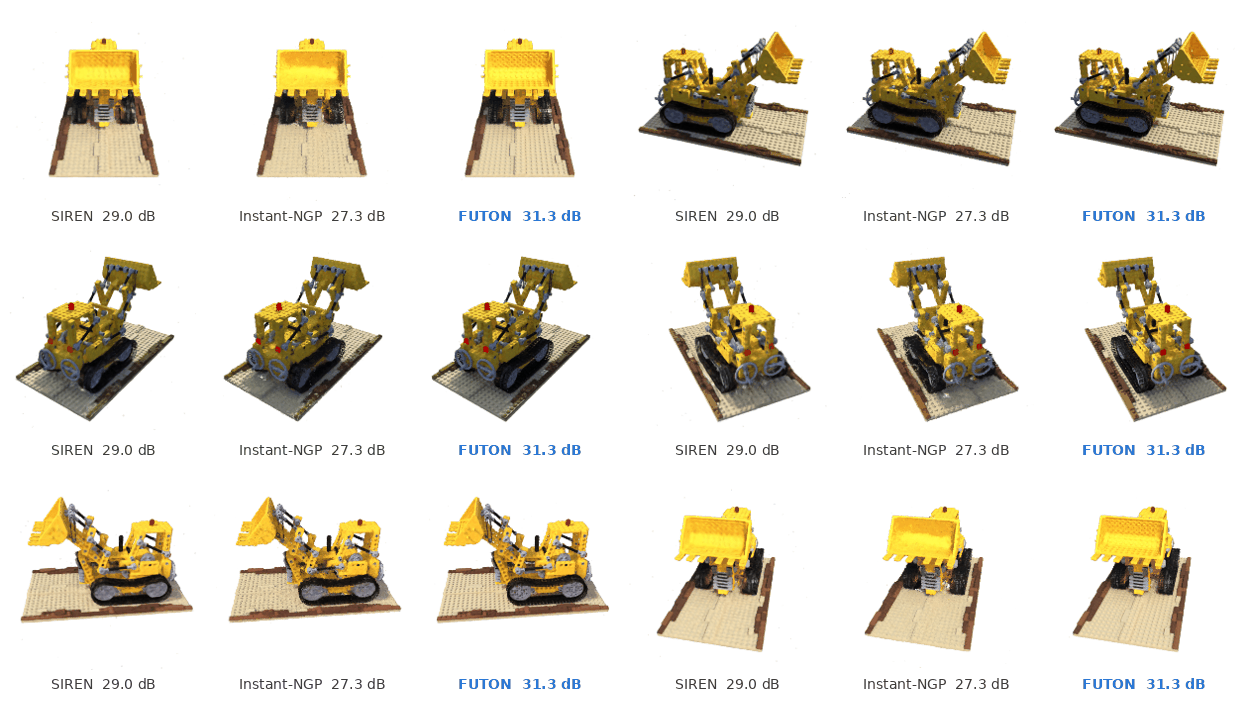
inro.nerf turns any model of the zoo into the density network of a radiance field, trains it on posed images by volume rendering, and scores held-out views. The protocol is FINER's, which is torch-ngp's Blender recipe: 200 × 200 views, 25 training views, scored on all 200 test views, here trained for 25,000 steps instead of 37,500. This follows configs/nerf.yaml and scripts/train_nerf.py.
- Raysfrom posed views
- Samplesalong each ray, in an occupancy grid
- Density networkany model of the zoo
- Color networkfeatures and view direction
- Volume renderinga pixel, against the target
Data
import torch
import inro

root = "data/nerf/blender/lego"
train_set = inro.nerf.BlenderDataset(root, split="train", downsample=4, skip=4)
val_set = inro.nerf.BlenderDataset(root, split="val", downsample=4)
test_set = inro.nerf.BlenderDataset(root, split="test", downsample=4)
downsample=4reduces the 800 × 800 renders to 200 × 200 by area averaging, andskip=4keeps 25 of the 100 training views.- Camera positions are scaled by
scene_scale=0.8into the box[-bound, bound]^3withbound=1, marching starts atnear=0.2, and the background is white. dataset[i]returns a full view's rays and RGBA, andsample_raysdraws random rays across views for training without materializing a ray buffer.
Field and renderer
field = inro.nerf.RadianceField(
    density_net=(inro.FUTON, {  # (1)!
        "basis": ("cosine", {"num_components": 100, "grid_size": 2048}),  # (2)!
        "combiner": ("cp", {"rank": 180}),
        "head": ("mlp", {"hidden_layers": 1, "hidden_features": 64}),
    }),
    color_net=("mlp", {"hidden_features": 64, "hidden_layers": 2}),  # (3)!
    geometry_features=15,
    direction_encoding="sh",
    aabb=train_set.aabb,
)
renderer = inro.nerf.create_renderer(aabb=train_set.aabb, near=train_set.near, far=train_set.far)
- Receives
in_features=3andout_features=1 + geometry_features: one density logit and 15 features, on positions mapped from the scene box to \([-1, 1]^3\). The field appliestrunc_expto the density, so the network has no output activation. - Samples along rays lie on no grid, so FUTON's basis would be evaluated at every one of them.
grid_size=2048reads it from a table of 2048 points per axis instead, each coordinate rounded to the nearest, 0.001 apart and finer than the marching step, which keeps a trained field's PSNR within a few hundredths of a decibel and renders and trains it in a fraction of the memory. - Maps the features and the encoded view direction to RGB (
"sh": 16 real spherical harmonics, as in Instant-NGP;"identity": raw directions, as in FINER). The field applies a sigmoid, so it has no output activation either.
Every model in the benchmark shares this color network and renderer; only the density network changes, so the comparison is between spatial representations.
create_renderer picks nerfacc when its CUDA extension works and the pure-PyTorch renderer otherwise. Both march rays through an occupancy grid (grid_resolution=128, updated every 16 steps) with a step of \(\sqrt{3} \cdot \text{extent} / 1024\) and at most max_samples_per_ray=1024 occupied samples.
Training
result = inro.nerf.train(
    field,
    renderer,
    train_set,
    eval_dataset=val_set,
    eval_indices=[0, 25, 50, 75],
    num_steps=25000,
    num_rays=4096,
    lr=1e-2,
    eval_interval=2500,
    log_dir="logs/tutorial/lego/FUTON",
)
Each step updates the occupancy grid, renders 4096 random training rays, composites predictions and targets onto a random background color, and takes an Adam step, with PyTorch's default settings and the learning rate decaying exponentially to lr / 10. A run of 25,000 steps takes FUTON a few minutes on an A100.
| Output | Content |
|---|---|
history |
step, elapsed, loss, the training psnr and num_samples every log_interval steps, and the mean validation metrics under "eval" every eval_interval |
log_dir |
The field's checkpoint.pt and renderer.pt, the renderer's state with its occupancy grid: load both to render a saved run as it was scored |
Learning rates in configs/nerf.yaml range from 3e-4 (SIREN, FINER) to 3e-2 (Instant-NGP, TensoRF-VM, GA-Planes), with FUTON at 1e-2.
Evaluation and rendering
scores = inro.nerf.evaluate(field, renderer, test_set)  # PSNR, SSIM and LPIPS on all 200 views
print(scores["mean"])
scores["views"] holds one record per view with its index, render time and metrics; return_images=True adds the rendered (H, W, 3) images; indices selects a subset. metrics accepts any fn(pred, target) on (3, H, W) images in \([0, 1]\).
To render new viewpoints, build camera-to-world poses and call render_views:
import imageio.v2 as imageio

poses = [inro.nerf.pose_spherical(theta, -30.0, train_set.radius) for theta in range(0, 360, 12)]
frames = inro.nerf.render_views(field, renderer, test_set, poses)  # list of (H, W, 3) uint8 arrays
imageio.mimsave("lego_orbit.gif", frames, duration=0.083, loop=0)
render_image(field, renderer, rays_o, rays_d) renders arbitrary rays, returning RGB, opacity and depth.
The benchmark script
scripts/train_nerf.py trains every model of the config on every scene under data/nerf/blender/, evaluates on the 200 test views, each rendered whole in one pass, and saves two rendered test views per run. The NeRF sweep is the long one: about five minutes per model and scene on an A100, 112 runs in all.